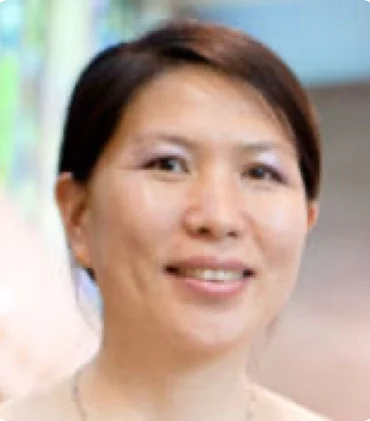
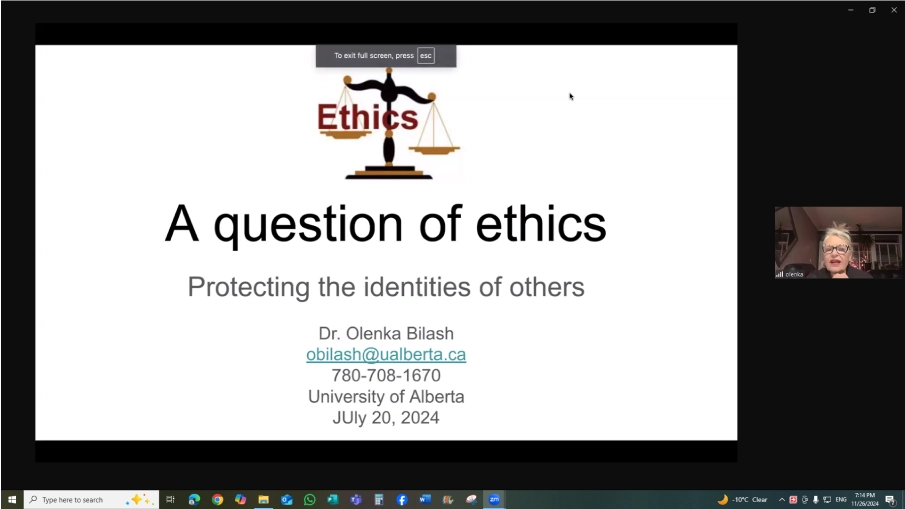
Olenka Bilash joined the staff of the Department of Secondary Education in 1992 after three years at the University of Calgary and almost two decades of experience as a second language teacher, supervisor, consultant, curriculum developer and conceptual designer. She has strove to create opportunities for learners of all ages to have experiences with new languages in and out of the classroom, including intercultural and inter-lingual exchanges for Education students and teachers. She has been active in numerous local organizations of second language teachers and offered second language education and teacher education seminars and courses in Brazil, Cameroon, China, France, Germany, Korea, Mexico, South Africa, Taiwan and Ukraine and mentored and guided many graduate students from around the world. She has two children, and apart from her academic pursuits, enjoys sculpture, yoga, hiking, and gardening. In 1999 she was awarded the Rutherford Award for Excellence in Undergraduate Teaching, the Faculty of Education Undergraduate Teaching Award at the University of Alberta, Northern Alberta Heritage Language Association 20th Anniversary Award and the Tribal Chiefs´ Association Award for her contribution to Developing Cree Language Materials. In 2005 she received an Alberta centennial medal for her contribution to international relationship building between Alberta and Ukraine. Her award-winning article, “Planning for Writing Instruction in a Middle-Years Immersion/Partial Immersion Setting” was inspired by a course taken early in her doctoral program with Donald Graves.
Good afternoon, everyone.
Have you ever wondered what it’s like to carry an entire homeland in your suitcase—and then find that it’s the stories, not the shoes, that you keep unpacking year after year?
Have you ever found yourself trying to explain where you’re from, only to realize that what you really want to say is who you’ve become—and how the road between the two is paved with both struggle and strength?
Have you ever paused on an ordinary day and asked yourself, “How did I get here? And who helped me along the way?”
These questions are at the heart of the beautiful new collection we are gathered to celebrate today: Edmonton Heritage Stories.
This isn’t just a book. It’s a constellation of voices. It’s a mosaic of memories. It’s a window into courage, vulnerability, and transformation—all held within the covers of a single volume, and carried by authors who are not only writers, but visionaries, bridge-builders, and keepers of lived wisdom.
Before I speak further, I want to take a moment—if you’ll indulge me—to go back in time.
I remember when I first arrived in Edmonton, in the late 1970s. I was a young teacher from Manitoba and Saskatchewan, full of curiosity and eager to contribute to the educational landscape. I settled just north of Norwood and made the daily commute to campus at the University of Alberta. It was a new chapter, full of possibility and unknowns… like the traffic circle.
In order to cross the high level bridge from the northside, there used to be a massive, confusing traffic circle. And I had never encountered one before. Not in Manitoba or Saskatchewan. Not on the written test for my beginner’s driver’s license. Not even in all the travel stories my extended family told me about North American cities.
Daily, I would approach that circle with the same optimism I brought to my new life—but end up driving around and around and around, mustering the courage to change lanes and exit … often praying to follow someone who looked like they were going in the same direction.
Some days, I got it right. Some days, I didn’t. But every day, I learned something about movement. About trust. About the awkward, beautiful process of finding your place in a system that wasn’t designed with you in mind.
That traffic circle, to me, has always symbolized what it feels like to arrive somewhere new. And I know I am not alone in that.
Each author in this book—Edmonton Heritage Stories—has navigated their own version of the traffic circle. They’ve arrived in Edmonton by different paths, at different stages in life: some as children following their parents, others as parents themselves; some by choice, some by circumstance; all with a courage they were yet to discover. And today, they offer us the gift of their stories.
There are stories in this book that speak of leaving behind beloved cities, familiar languages, and cherished traditions. There are stories that chronicle the quiet ache of missing home and mourning people, of navigating a new culture, of translating one’s identity in real time.
But there are also stories of joy—of resilience blooming like prairie flowers, of unlikely friendships, of laughter in the kitchen, of learning to love snow or savour Tim Hortons coffee or cheer for the Oilers like you were born in blue and orange. And every single one of them is a contribution to our collective understanding of what it means to call Edmonton home.
Each story also quietly reminds us that moving to a new place doesn’t just involve crossing borders. It involves crossing emotional terrain—grappling with language, identity, and belonging. It means rebuilding a sense of community, often from scratch. And doing so while working hard, raising families, and often carrying the hopes of loved ones left behind. It means finding yourself.
This is no small feat
I am especially honoured to recognize the vision and leadership of the very humble Dr. Wenying (Cathy) Shi and the Edmonton Chinese Writing Club, whose dedication made this book possible. It took nearly two years to gather and nurture these stories—and every hour was worth it.
Dr. Shi, thank you for holding this vision with such care and persistence. You created space for stories that too often go untold. You applied for grants, found publishers, and offered and arranged for guidance, mentorship, and warmth for the writers. And you reminded all of us that literature is not only the realm of the professional writer, but of every soul brave enough to speak their truth. You believed that every person has a story worth telling—and, importantly, worth hearing. This book would not exist without you.
To the authors: thank you. Thank you for your bravery. Thank you for your generosity. Thank you for your humour, your honesty, your unfiltered humanity. Many of you wrote these pieces in your second—or even third—language. That alone is remarkable.
But even more remarkable is the way you opened your hearts. You wrote about family members, homes left behind, expectations unmet, contexts both kind and cruel, and about the small victories that most people will never see but that mark the arc of resilience—learning to drive, getting your first library card, making dumplings that taste like your mother’s.
You reminded us that heritage is not only what we inherit, but what we create. And that belonging is not a place on a map—it’s the place in our stories where someone recognizes themselves.
I also want to acknowledge the community that supported this project: the team of workshop leaders, editors, translators, and artists who brought each story to life. Their thoughtful contributions—from writing workshops to ethical reflections to design decisions—helped ensure that this book is not just meaningful, but beautiful.
Indeed, when I first received my copy two days ago, I was stunned. Not only by the content, but by the book itself—the textured pages, the artwork accompanying each narrative, the bold colored dividers offering quiet moments of reflection, the poetry. Kudos to Jamie Laventure, Ulrike Rossier, Ramond Keung, Randy Stennes, Amyniah Pyrani, Sheila C and Jarred Quinney, Eli Abada, and Aaron Harvey from the Nina Haggerty Centre and Eoshanelle Francisco for their images.
In a world where so much reading is done on screens, this book is a tactile treasure. You don’t just read it—you hold it. You absorb it. You carry it with you. And the stories carry you in return.
There’s something deeply healing about storytelling. For the writer, it’s a chance to reflect, to reframe, to reclaim. For the reader, it’s an invitation to walk in someone else’s shoes—and maybe recognize the shape of your own steps along the way.
This book does both. It gives authors the chance to make meaning of their journey. And it gives readers the gift of perspective—of seeing the familiar anew, of understanding Edmonton and its Chinatown, Giovanni Caboto Park, Norquest College, the Hudson’s Bay Store, The Royal Alec, Edmonton Transit, Hope Mission, Lucky 97 and Old Strathcona through lenses shaped by China, Hong Kong, Taiwan, Nepal, The Phillipines, Switzerland, Italy, Ukraine, Wolf creek and Red Deer Alberta, Manitoba and Quebec.
It reminds us that we are not a city of strangers, but a city of stories. Stories that intersect at unexpected moments. Stories that circle around each other until, like me in that old traffic circle, we find someone to follow. Someone who helps us find our exit—or maybe a new route altogether.
To all those gathered here today—families, friends, fellow readers, and new acquaintances—I encourage you not only to buy this book and read it, but to share it. Pass it on. Start a conversation. Ask your neighbour, “What was it like when you first arrived?” Then listen. Listen as if you are being gifted something sacred. Because you are.
And as you read be sure to look for why some call Edmonton the city of love!
As I stand here, I feel deep gratitude—for the opportunity to be part of this moment. For the reminder that stories are the bridges between hearts. And for the belief that, together, we are shaping a city where every voice matters.
Let me close by returning to those early days, when I was still circling, unsure of how to exit or where I belonged. If someone had told me then that I would one day be standing here, speaking about a book like this one, I would have smiled politely—but I’m not sure I would have believed them. But that’s the magic of stories. They don’t just describe what is—they show us what’s possible. They help us imagine a future that includes all of us.
And so, to the authors, the visionaries, and everyone who played a part in this book’s creation: congratulations. Thank you. And may Edmonton Heritage Stories inspire not only memories, but new beginnings.
Thank you.
Job done
k
Marketing agency
Creative Business Consulting Group
Digital marketing Suspendisse ullamcorper sem a tristique molestie. Suspendisse egestas interdum. passages of lorem in free market to available
Arandomised available, but the majority have suffered alteration in some form, by injected humour, or randomised words which don’t look even slightly believable.
Riad Mahfuz Chief UI Ux Designer
digital Nice agency
Guffered available, but the majority have suffered alteration in some form, by injected humour, or randomised words which don’t look even slightly believable.
Kashif Bhatti web Designer
Business Success
Yatyajority available, but the majority have suffered alteration in some form, by injected humour, or randomised words which don’t look even slightly believable.
Foorkan Sho Marketing manager
Finance Consulting
How do you take high-end customer service
Different Thinking
Using data-driven insights to fuel results-driven giver
Business Innovation
Bringing together execution and vision make sure
We believe in making the world a better experience
Subsrcibe for our upcoming latest articles and resources
 Professionals


 Marketing